What Is a Smart Flower Pot? A Complete Guide to Smarter Plant Care
Learn how a smart flower pot uses sensors, plant profiles and automatic watering to make indoor plant care more consistent and less stressful.
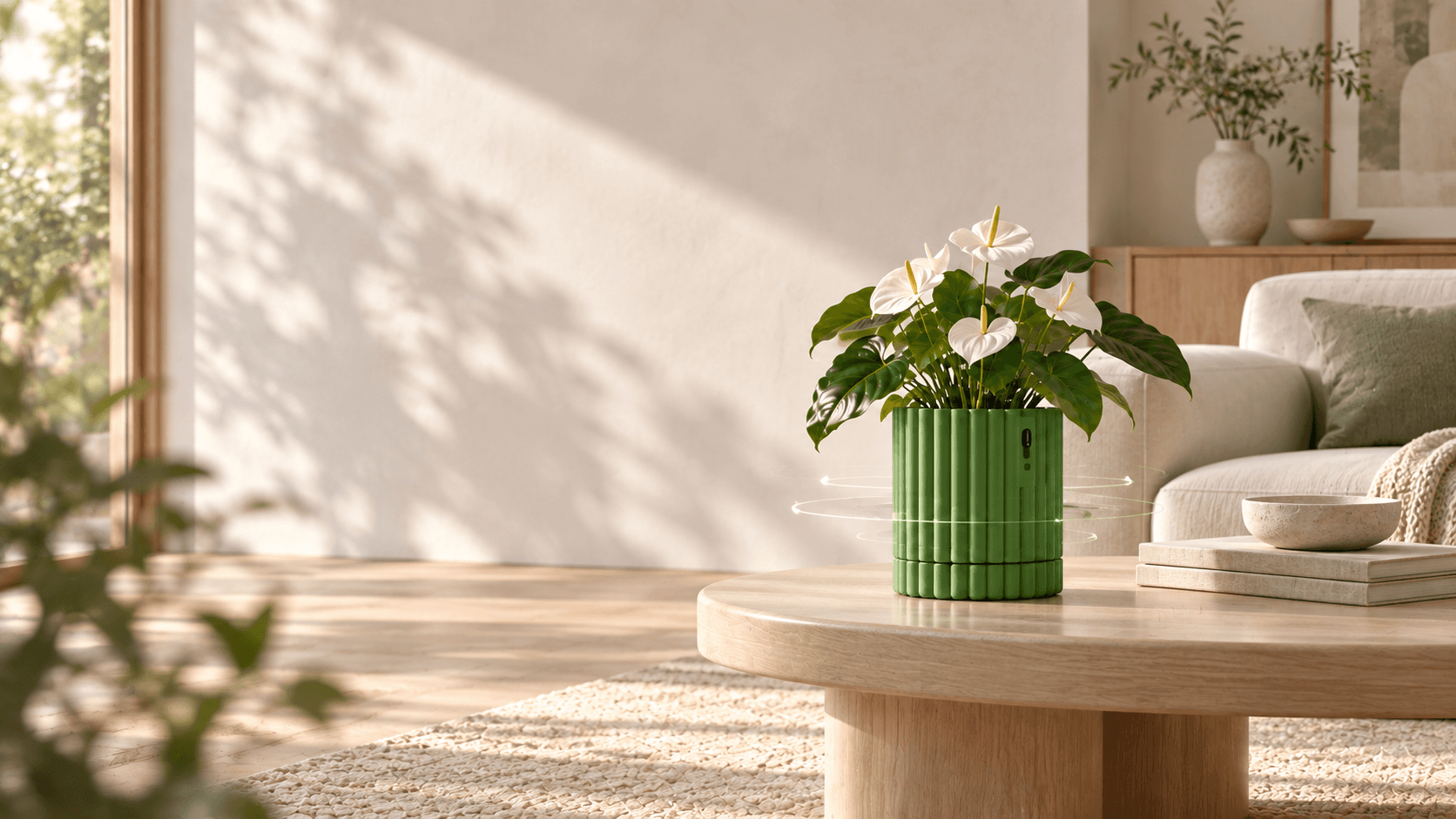
A smart flower pot is a planter that uses sensors, software and, in some designs, automatic watering to respond to a plant’s actual conditions. Instead of asking you to remember a fixed watering day, it can observe what is happening around the roots, compare those readings with a plant-specific care profile and help deliver the right action at the right time.
That sounds simple, but it addresses one of the hardest parts of indoor plant care: plants do not live by our calendars. The same pothos may dry quickly beside a bright summer window and much more slowly during a cool, dim week. Pot size, soil, leaf area, temperature and airflow all change the rate at which water is used. A reminder that says “water every Sunday” cannot see any of that. A well-designed smart plant pot can.
This guide explains what smart pots do, how they differ from ordinary self-watering pots, which features matter and where human judgment still belongs.
The simple definition
At minimum, a smart flower pot measures one or more conditions and turns those measurements into useful guidance. A more complete smart planter can also act on the information by running a small pump from an integrated water reservoir.
Most systems follow the same four-part loop:
- Sense: a probe reads soil moisture, while other sensors may track light, temperature or humidity.
- Interpret: software compares recent readings with a target range for the selected plant.
- Act: the system sends a notification or waters automatically when its rules are met.
- Learn and report: an app presents trends, watering history and alerts so the owner can understand what changed.
The word “smart” should therefore mean more than adding Bluetooth to a planter. The value comes from closing the gap between a reading and a reliable care decision.
Smart flower pot versus an ordinary planter
An ordinary planter holds soil and provides a physical home for roots. Its success depends on the plant, potting mix, drainage and the person caring for it. It can be beautiful and perfectly effective, but it does not know whether the soil is wet or dry.
A passive self-watering pot adds a reservoir. Water usually moves into the growing medium through a wick or capillary action. This can extend the time between refills, yet the pot generally does not measure the root zone or make a plant-specific decision. Water remains available as long as the reservoir and wick are connected.
A smart planter adds feedback. It can tell the difference between “water is available” and “this plant’s soil has crossed a defined threshold.” In an active system, a pump can deliver a measured amount only after the sensor and software agree that watering is appropriate.
There is also a third category: connected plant monitors. These place a sensor in a conventional pot and send reminders to a phone, but they do not water. They can be useful if you want data while retaining full manual control.
What can a smart plant pot measure
Soil moisture
Soil moisture is the core signal in most smart pots because it answers the immediate question: how much water is present around the roots? The useful part is not a single percentage in isolation. It is the pattern over time—how quickly the medium dries, how it responds after watering and whether it remains wet for unusually long periods.
Different sensors and potting mixes produce different numeric ranges, so a reading should be interpreted through the product’s calibration and the selected plant profile. “Forty percent” is not a universal botanical truth. Consistency within one system matters more than comparing numbers from unrelated devices.
Light
Light strongly influences growth and water demand. A plant receiving brighter light often uses water faster than the same plant in a dim corner. Light data can help explain why a previously stable routine has changed, although a sensor at pot level may not capture every detail of the light reaching the leaves.
Temperature and humidity
Warm air, heating, air conditioning and low humidity can alter how quickly a plant and its soil lose moisture. Temperature and humidity readings add context. They should not be treated as a substitute for choosing a suitable location, but they can make alerts and trends more intelligible.
Reservoir and device status
An automatic watering flower pot also needs to know whether it can complete the action. Low-water alerts, pump status, connectivity and last-contact time are practical signals. A perfect moisture algorithm cannot help if the reservoir is empty or the device has been offline for days.
How an AI plant pot uses plant profiles
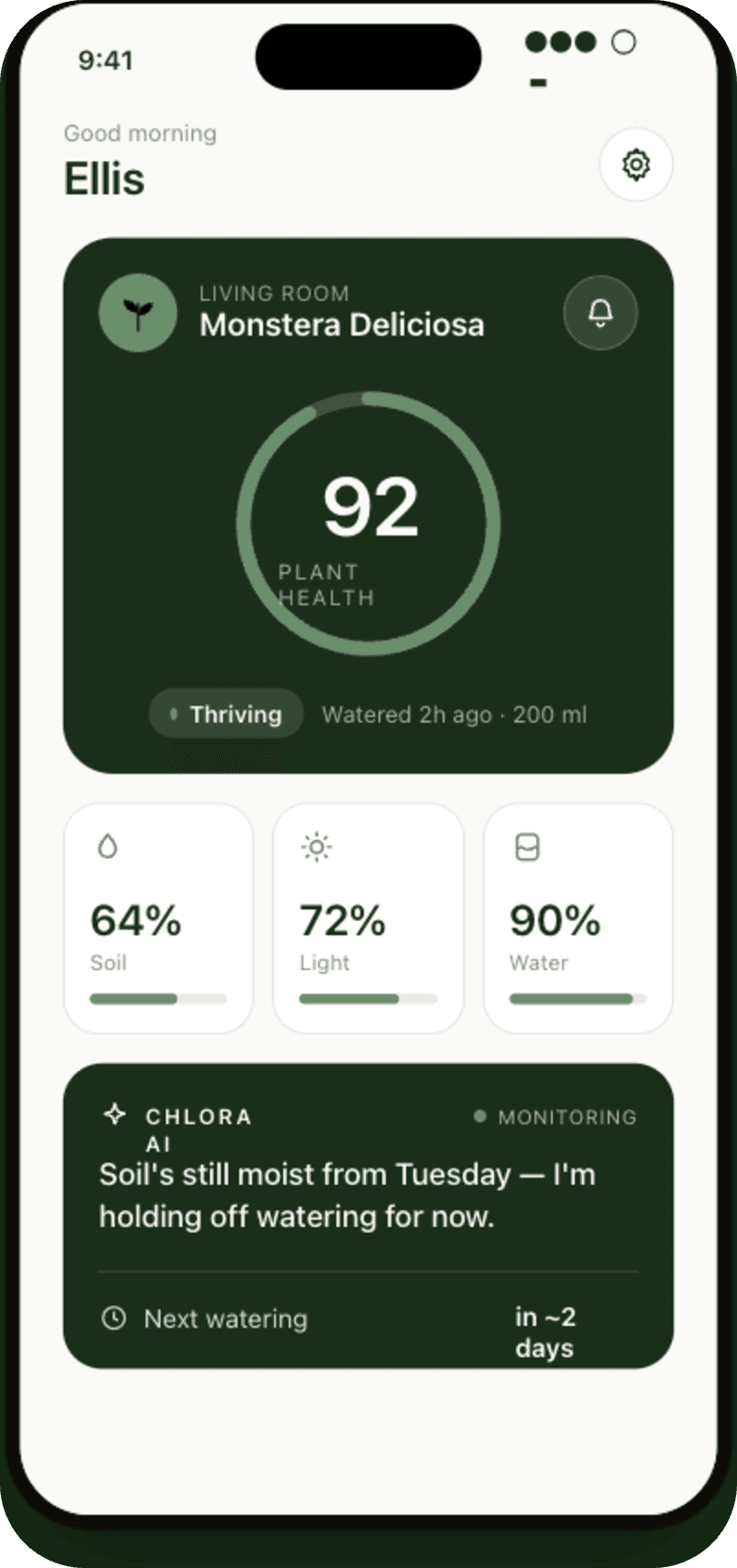
“AI plant pot” is often used broadly. The important question is what intelligence actually changes. A credible system should connect sensor history with the needs of the plant, rather than producing generic chat or decorative scores.
Plant profiles can define a preferred moisture band, watering volume, check frequency and light expectations. The profile for an anthurium should not behave like the profile for a cactus. More advanced systems can use recent patterns to explain why the plant needs attention and present that information in ordinary language.
Chlora is being developed around care profiles for more than 500 plants. The selected profile informs moisture and watering behavior, while the app brings together readings, care status, watering history, notifications and conversational guidance. The purpose is not to make the plant feel technical. It is to make the technology recede until care feels calmer.
The practical benefits
Fewer decisions based on guesswork
The classic finger test is still useful, but it is subjective and samples only the spot you touch. A plant pot with sensors can check consistently and keep a history. That helps separate an occasional dry surface from a root zone that is actually becoming too dry.
More consistent watering
University extension guidance commonly recommends letting the plant and soil guide watering rather than following a rigid calendar. A sensor-led system is well suited to that principle: it can wait during slow-drying periods and respond sooner when conditions speed up water use.
Better visibility when you are busy or away
Notifications can reveal an empty reservoir, an offline pot or an unexpected moisture pattern before the next time you happen to inspect the plant. Automatic watering can also reduce dependence on a neighbor for short trips, provided the system has been tested and the reservoir has enough capacity.
A record of what happened
Watering problems are difficult to diagnose from memory. A history of readings and water delivery gives you something concrete to review. If the soil stays wet for too long, the answer may involve drainage, compacted mix, low light or an oversized pot—not simply “water less.”
What a smart planter cannot do
Smart care does not remove biology. A sensor cannot compensate for root rot, unsuitable soil, a blocked drainage path, severe pests or a plant placed in the wrong light. It also cannot make an empty reservoir water a plant.
Readings can be distorted by poor probe contact, air pockets, mineral buildup or a sensor installed in an unrepresentative part of the pot. Newly repotted plants may also behave differently while soil settles. The best systems make status and limitations visible rather than pretending every number is absolute.
Automatic watering should be conservative. If data is missing, contradictory or out of range, pausing and asking for attention is usually safer than pumping repeatedly. A reassuring product is not one that always acts; it is one that knows when not to.
What to look for before buying a smart flower pot
Start with the care system, not the feature list.
- Plant-specific rules: Can you select the species or adjust its target range?
- Root-zone sensing: Is moisture measured where it matters, and is the reading easy to understand?
- Controlled watering: Does the system use a pump or another mechanism to deliver a known amount?
- Reservoir visibility: Will you be alerted before water runs out?
- Clear history: Can you see when the plant was checked and watered?
- Safe failure behavior: What happens when Wi-Fi, power, data or water is unavailable?
- Manual control: Can you request a small, standard or deeper watering when appropriate?
- Privacy and longevity: Is data use explained, and can the planter still provide basic value if an online service changes?
- A pot you want to live with: A smart planter is furniture as much as a device. Size, finish, cleaning and noise matter every day.
Avoid judging a product by the number of sensors alone. One dependable moisture signal, paired with clear rules and cautious watering, may be more useful than a dashboard full of unexplained metrics.
Is a smart flower pot worth it
A smart pot is most valuable when the cost of inconsistency is high: you travel, care for several plants, struggle to read moisture, or own plants that react poorly to repeated wet-dry extremes. It can also suit people who enjoy plants but do not want another demanding routine.
It may be unnecessary for a tiny collection that already thrives under attentive manual care. Dry-loving succulents in very gritty soil may benefit more from a simple pot with excellent drainage than from frequent automation. And some growers genuinely enjoy the ritual of checking every plant by hand.
The better question is not whether technology is always superior. It is whether feedback and controlled watering solve a real problem in your home.
A quieter model of plant technology
The most promising smart planters do not turn a living room into a control room. They observe quietly, explain only what matters and act within sensible limits. The design goal is confidence: you should know whether the plant is comfortable, what the pot did and what—if anything—you need to do next.
That is the idea behind Chlora: a living object for healthier plants, with autonomous care shaped by plant profiles rather than a fixed schedule. Chlora One combines soil sensing, an integrated reservoir and pump, app guidance and notifications in a sculptural indoor planter. Chlora is currently building toward Kickstarter.
Frequently asked questions
Does a smart flower pot water the plant automatically
Some do and some do not. Sensor-only products provide readings or reminders. Active smart planters include a reservoir and watering mechanism that can deliver water when defined conditions are met. Check whether “smart” means monitoring, automatic watering or both.
Does a smart pot need Wi-Fi
It depends on the product. Chlora One uses 2.4 GHz Wi-Fi for connected app features. A well-designed system should clearly explain which functions continue locally if the connection drops and should alert you when it has been offline.
Can I use any plant in a smart planter
Compatibility depends on pot size, root structure, soil and the care profiles available. Plants that appreciate fairly consistent moisture are often natural candidates. Plants that require a pronounced dry period need carefully tuned rules and very free-draining soil.
Can a smart planter prevent overwatering
It can reduce schedule-based watering and show when soil remains wet, but it cannot guarantee prevention. Drainage, soil structure, sensor placement and plant health still matter. Conservative automation and clear status are essential.
How often do I refill the reservoir
Refill frequency depends on reservoir size, plant size, season, light, temperature and watering volume. Use the product’s level alert and observe real consumption before relying on it for travel.
Sources and further reading
- University of Minnesota Extension, Spring houseplant care: https://extension.umn.edu/garden-and-home/yard-and-garden/gardening-in-minnesota/houseplants/spring-houseplant-care
- Royal Horticultural Society, How to help a poorly houseplant: https://www.rhs.org.uk/plants/types/houseplants/how-to-help-a-poorly-houseplant
- Chlora product and app source material: Chlora website and Chlora One user manual